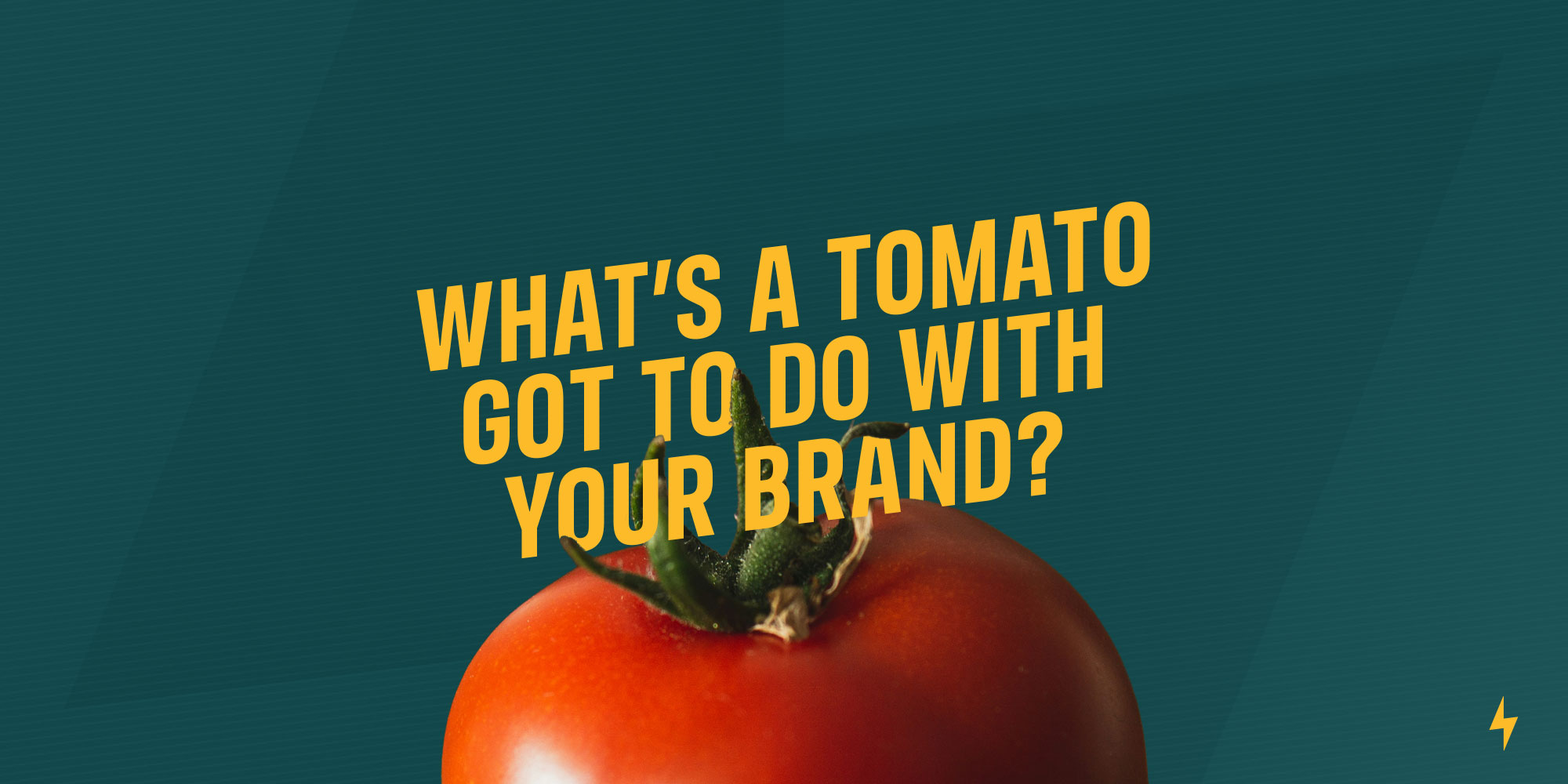
What's a tomato got to do with your brand?

This is an analogy I’ve used for a few years now. It always gets people nodding as the meaning sinks in.
At some point in almost every brand workshop, someone says something like this...
"We can't use that word – our competitors use it too."
"Collaborative feels too generic. Everyone says they're collaborative."
“We need something unique, something other companies aren’t saying.”
And so the list of potential values gets whittled down in search of something nobody else has claimed, until what's left is either so obscure it means nothing or so carefully worded it sounds like it was written by a committee. Which it was.
The instinct isn't wrong. Finding language that's specific, honest and exactly right for a particular business is always the goal. Generic values listed on a wall and promptly forgotten are a genuine problem. Not because the words are bad, but because they've been chosen for convenience rather than conviction. They haven't been worked out properly.
But the solution isn't to avoid the word. It's to do the work behind it. Find the thing BEHIND the thing.
Tomatoes and branding
Here’s where the tomato comes in.
Put it in a bolognese and it's rich, slow-cooked, deeply savoury.
Put it in a BLT and it's fresh, sharp, textural.
Put it in a curry and it's a sweet background note, holding everything else together.
Same ingredient. Completely different job.
Brand language works the same way.
Let’s use that much maligned (but tricky to avoid) word, "Collaborative". In a law firm, it might mean structured, carefully managed client relationships with clear lines of responsibility. In a creative agency it might mean the client is genuinely in the room – challenging, contributing, co-creating rather than just approving. Same word. Different flavour. Different role in the recipe.
Can you see how the word isn’t necessarily the problem? It’s what it really means – and really digging into that often helps you either find a better word or build a clearer picture of why it’s relevant.
Don’t avoid tomatoes (necessarily)
The question worth asking isn't "has someone else used this word?" It's "what does this word actually mean for us? How does it show up? What decisions does it drive? What would we do differently because of it that a competitor with the same word on their website wouldn't?"
That's where the distinctiveness lives. Not in the ingredient. In what you do with it.
So yes – always push for language that's specific and exactly right. If there's a better, more precise word that captures something true about a business, find it. That work is worth doing and it usually produces something more interesting than the first answer that comes up.
But if that work has been done properly – if a value has been genuinely interrogated, tested against real decisions and real behaviour, and the right word turns out to be one a competitor uses too – don't throw it out. The problem was never the word. It was the lack of thinking behind it.
When to avoid
I promised not only guidance on when to embrace the tomato, but when to avoid. And here it is.
When you pick a word that's ubiquitous to your sector, has no nuance, or doesn't affect daily decision-making in an authentic and distinctive way – that's when you need to dig deeper. What you want to find is a distinctive and authentic recipe of core parts of your identity – not just nice words that feel like people would respond well to them.
Let's use that 'collaborative' word as our example again.
If you're using it because:
(a) you think you should ("Our clients would expect us to say we're collaborative, and our competitors do, so we don't want to fall behind")
(b) you haven't really thought about what you do that's collaborative ("Well there are a few of us in the team so naturally, we must be collaborative")
(c) you haven't yet worked out WHY you're collaborative beyond operational necessity ("We work well together with our clients because we have to").
... then you might need to reconsider it.
But if you can point to the thing behind the thing – why being collaborative is such a critical ingredient to everything you do – and can clearly prove that your reputation and how you deliver results is wrapped up in collaboration, then maybe it's worth owning as part of your brand recipe.
I say tomarto. You say tomayto. The tomato might be just fine. It's what you do with it that matters.
--
Getting to language that's genuinely specific and true is at the heart of the Identity Clarifier Process™. If you'd like to understand what that looks like in practice, start here – or book a 30-minute intro call.
Photo by Andre Taissin on Unsplash
Heard enough, and want action?
Explore our thought process more or discuss your own brand challenge by booking a call now.